USAII Global AI Hackathon FinalistUndergraduate track · 2026
Responsible AI • Backend Systems
Umme Fatima
Sadia Hossain
AI & Backend Software Engineer
I build responsible, evidence-grounded systems for healthcare, public services and resilient communities.
AI/backend roles & graduate research

Dual-award BSc (Hons) Software EngineeringAPU · De Montfort University
9 Engineering ProjectsResponsible AI · Backend · Data
Engineering + research profile
Engineering depth with a responsible-AI research direction.
My work connects software engineering discipline with responsible AI: defining a real problem, designing the system boundary, building the backend, grounding outputs in evidence and showing where human judgement must remain in control.
Technical depth
Full-stack systems, backend APIs, data pipelines, deployment and testing—not interface mock-ups alone.
Research intent
Projects are framed around uncertainty, evidence provenance, safety constraints and evaluable user needs.
Public impact
Healthcare, housing, food security, infrastructure resilience and trustworthy organisational decisions.
Evidence & reflection
Public repositories, demos, finalist recognition, academic documentation and transparent project limitations.
Selected engineering work
Case studies built around consequential problems.
Each project is presented through the same lens: the problem, my engineering contribution and the evidence that the work exists.
01
Healthcare AI · Care navigation
SenoNav AI
An evidence-aware breast-cancer triage and cross-border care-navigation prototype designed to turn fragmented reports into clearer next-step guidance.
Problem
Patients often receive complex reports but lack a structured path for urgency, referral readiness and international treatment planning.
My engineering contribution
A Streamlit workflow for report ingestion, structured triage, referral preparation, multilingual access and safety-first explanations with human escalation.
Evidence
Built and submitted for AMD Developer Hackathon Act II, with a public working repository and demonstrated care-navigation flow.
02
Public-service AI · Human-in-the-loop
GharDisha AI
A trusted-helper system that converts disaster-displaced families’ housing stories into source-grounded PMAY-G preparation plans.
Problem
Rural families may struggle to explain urgent housing circumstances, collect evidence and prepare for Gram Panchayat or BDO verification.
My engineering contribution
A responsive full-stack case interpreter with document/photo input, multilingual interaction, curated grounding, readiness scoring and explicit human authority boundaries.
Evidence
Advanced to the final round of the USAII Global AI Hackathon 2026 at undergraduate level.
03
Multi-agent AI · Live web intelligence
Sentinel Web-Risk Intelligence
An autonomous third-party risk platform that gathers live evidence, verifies vendors and produces explainable predictive risk intelligence.
Problem
Traditional vendor assessments become outdated quickly and rarely connect fragmented public signals into a continuously updated risk picture.
My engineering contribution
A six-agent investigation workflow covering reconnaissance, scraping, verification, intelligence, prediction and reporting, supported by live Bright Data infrastructure.
Evidence
Submitted to the Web Data Unlocked Hackathon with public source, a live-data architecture and an auditable multidimensional risk score.
04
Final-year research project · Full stack
Gamified Habit Tracker
A research-informed productivity system that combines configurable habit tracking with points, streaks, badges, reminders and visual progress insights.
Problem
Habit formation often fails when motivation declines and users cannot see meaningful feedback or consistency over time.
My engineering contribution
A layered Django application with secure authentication, domain rules, achievement logic, Chart.js insights, PostgreSQL persistence, Docker support and automated tests.
Evidence
Submitted as the BSc (Hons) Software Engineering final-year project on 30 April 2025, supported by requirements research and Kanban delivery.
Project atlas
Five more systems across AI, data and software engineering.
05
Geospatial intelligence
MyBENTENG
Automated geospatial intelligence for flood-resilient infrastructure planning in Malaysia, translating spatial indicators into decision-ready risk insights.
Research prototypePythonGISFlood resilienceData analysis
Repository 06
Food security · Agent systems
AgriNexus Operations Hub
A proactive national food-security hub using a Google ADK multi-agent swarm for crop pathology, regional risk detection and agricultural logistics.
Hackathon buildPythonGoogle ADKGeminiMulti-agent
Repository 07
Scientific interfaces · 3D systems
NASA Vibe Station
A mission-control simulator combining orbital telemetry, a Three.js Earth visualisation and a Gemini-powered autonomous science officer.
Interactive prototypeReactThree.jsGeminiCloud
Repository 08
Enterprise logistics orchestration
Vanguard Milano
An experimental AI logistics orchestrator that detects transport disruption, evaluates rerouting choices and explores automated settlement workflows.
Experimental buildPythonAI orchestrationLive feedsx402
Repository 09
Experimental software engineering
Galaxium Travels: Chronos
A futuristic travel-booking concept exploring relativistic time synchronisation, created for IBM Dev Day with an emphasis on coherent domain modelling.
IBM Dev Day buildPythonIBM BobSimulationDomain logic
Repository Graduate research direction
Reliable AI decision support for high-stakes, imperfect-information environments.
I want to investigate how retrieval, agent orchestration and human oversight can produce useful assistance without hiding uncertainty or overstating authority.
“The goal is not to automate every decision. It is to design systems that help people reason with better evidence, clearer boundaries and accountable human control.”
01Evidence grounding
Trace outputs back to curated or live sources.
02Uncertainty handling
Separate confirmed, missing and conflicting information.
03Human oversight
Keep consequential decisions with qualified people.
04Evaluation
Measure usefulness, safety, reliability and user trust.
Academic journey
A software-engineering foundation shaped into an AI research profile.
Educated in Malaysia through a dual-award Software Engineering degree from Asia Pacific University and De Montfort University, with interests in graduate research and AI/backend engineering.
Dual-award BSc (Hons) Software Engineering
Asia Pacific University of Technology & Innovation and De Montfort University. Academic foundation in architecture, testing, requirements, databases, programming and data analysis.
Final-year research submission
A Gamified Solution for Habit Formation and Productivity Enhancement—a full-stack Django system supported by user research, software design and iterative Kanban delivery.
Professional and collaborative practice
Completed a 16-week APU Career Centre internship supporting cross-functional programmes, stakeholder coordination, event operations and student engagement.
Applied AI portfolio
Built systems across health navigation, public services, web-risk intelligence, geospatial resilience, food security and scientific interfaces; advanced to the USAII Global AI Hackathon final round.
Engineering toolkit
Tools I use to build reliable, testable systems.
Backend
PythonFastAPIDjangoREST APIsPostgreSQLSQLite
AI systems
RAGMulti-agent workflowsGeminiQwenCrewAIGoogle ADK
Data & cloud
DockerBright DataChromaDBGISAWSCI/CD
Interfaces
ReactNext.jsStreamlitJavaScriptThree.jsChart.js
Verified credentials
Selected awards and professional learning.
Every item below links to the original certificate evidence. Sensitive academic records remain private.
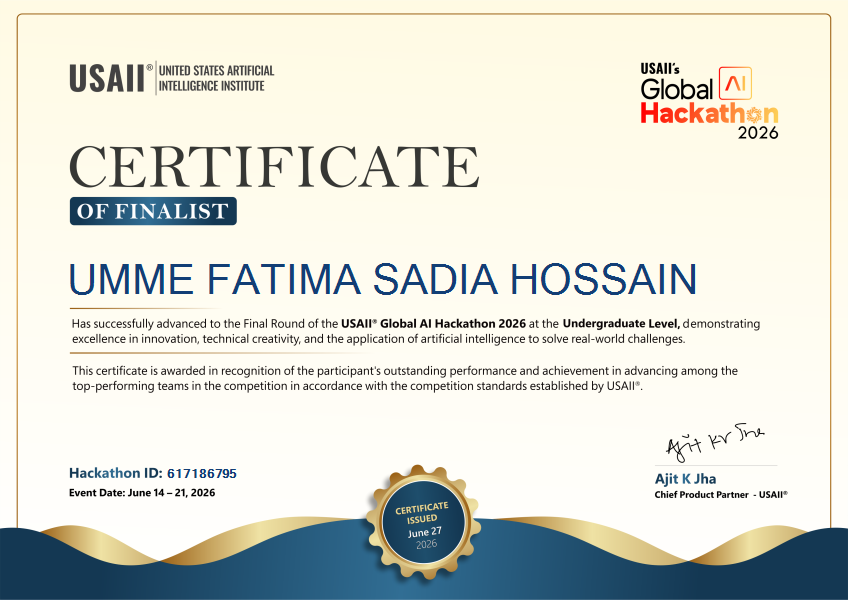
01
USAII Global AI Hackathon Finalist
United States Artificial Intelligence Institute · Undergraduate level
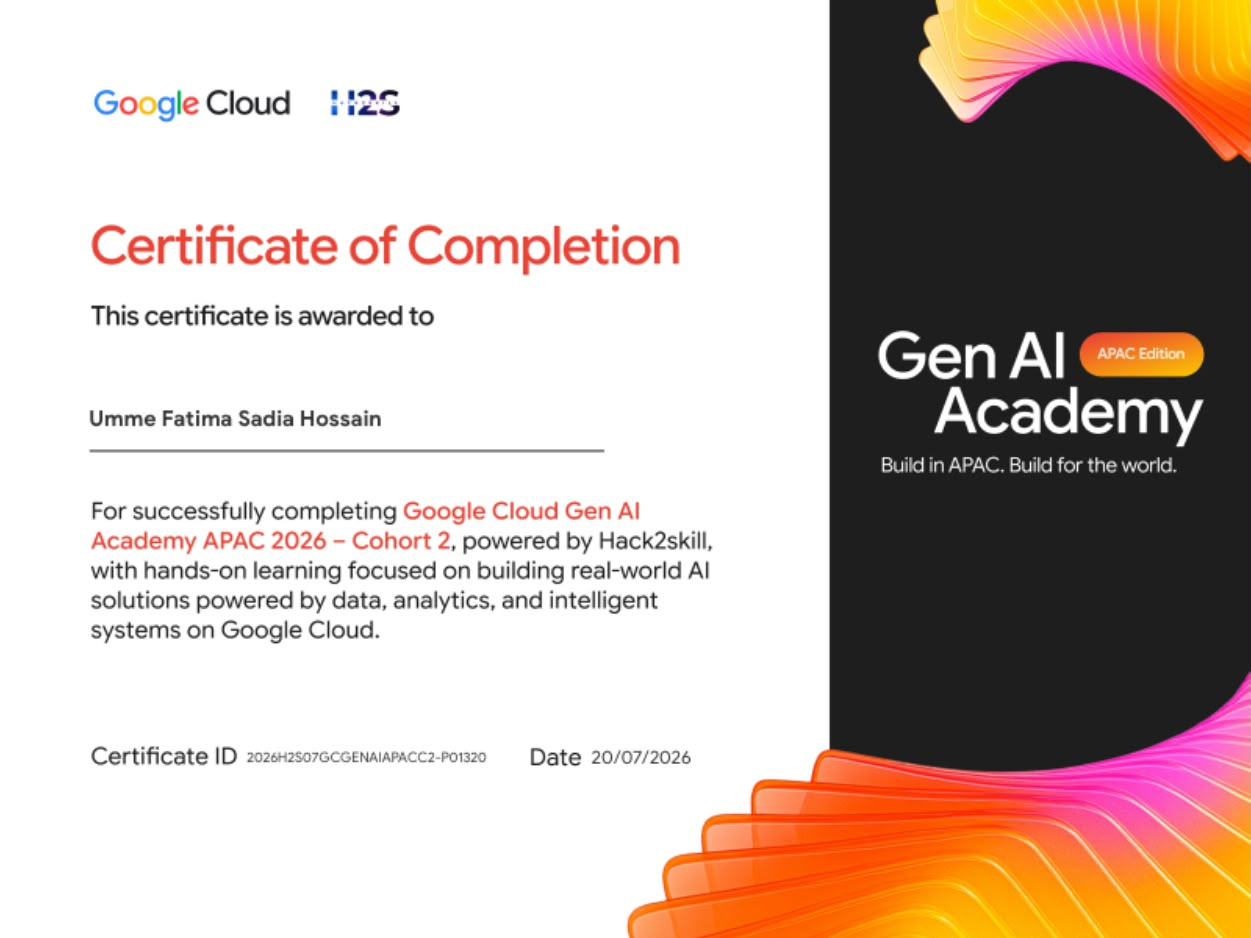
02
Google Cloud Gen AI Academy APAC — Cohort 2
Google Cloud × Hack2skill · Completed 20 July 2026
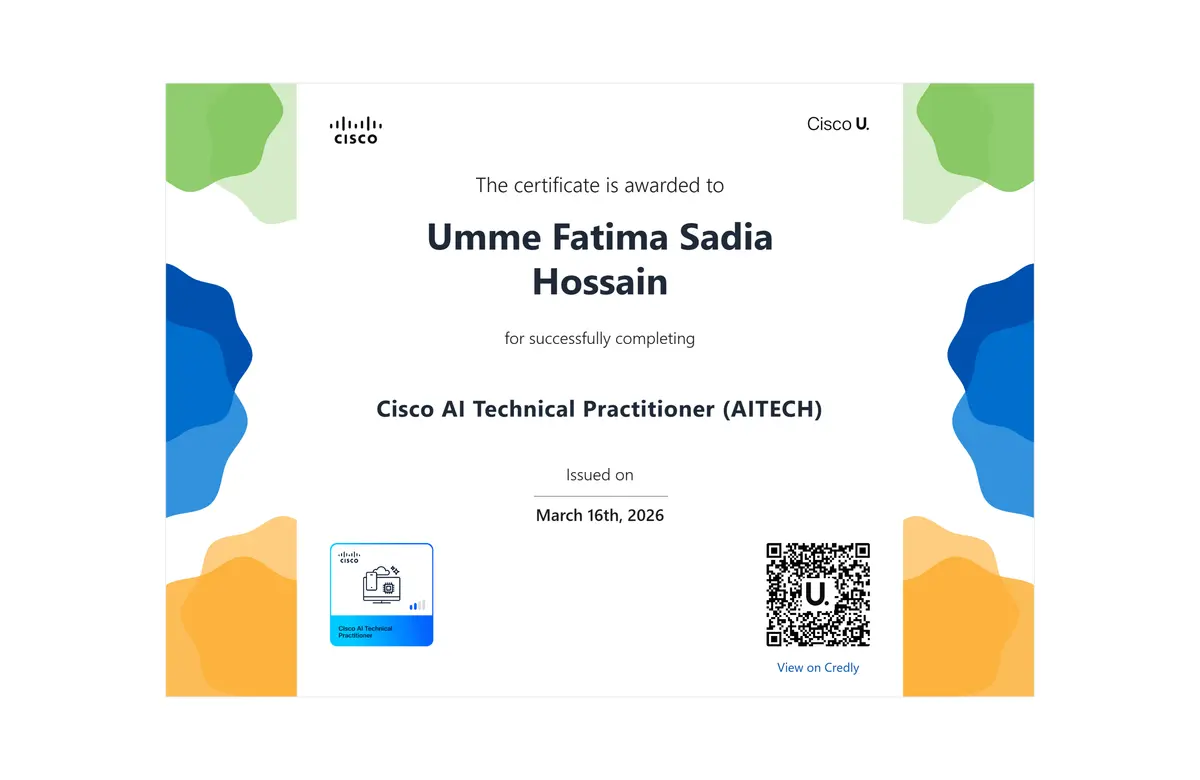
03
Cisco AI Technical Practitioner
Cisco U. · Issued 16 March 2026
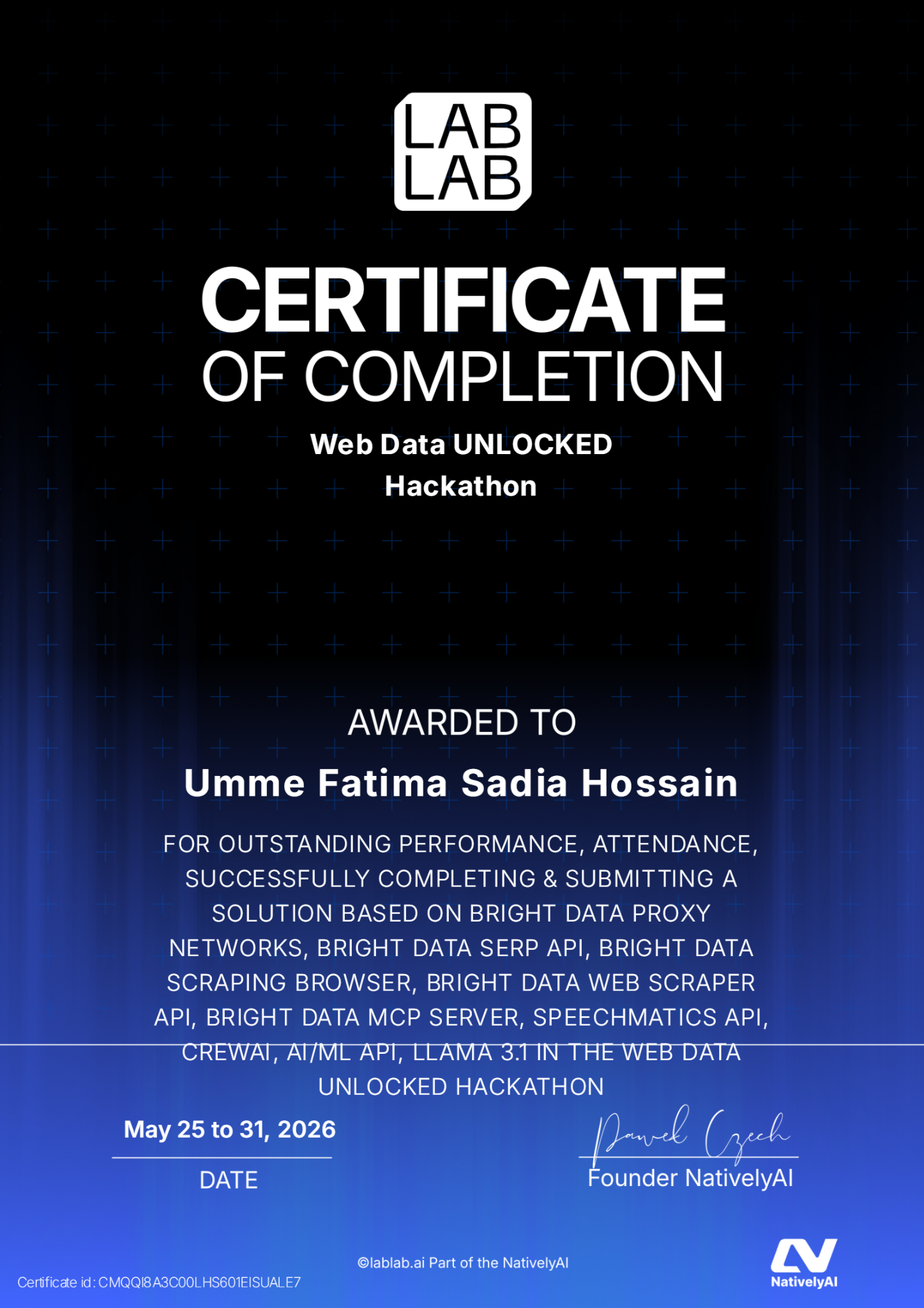
04
Web Data Unlocked
Lablab.ai · Bright Data
05
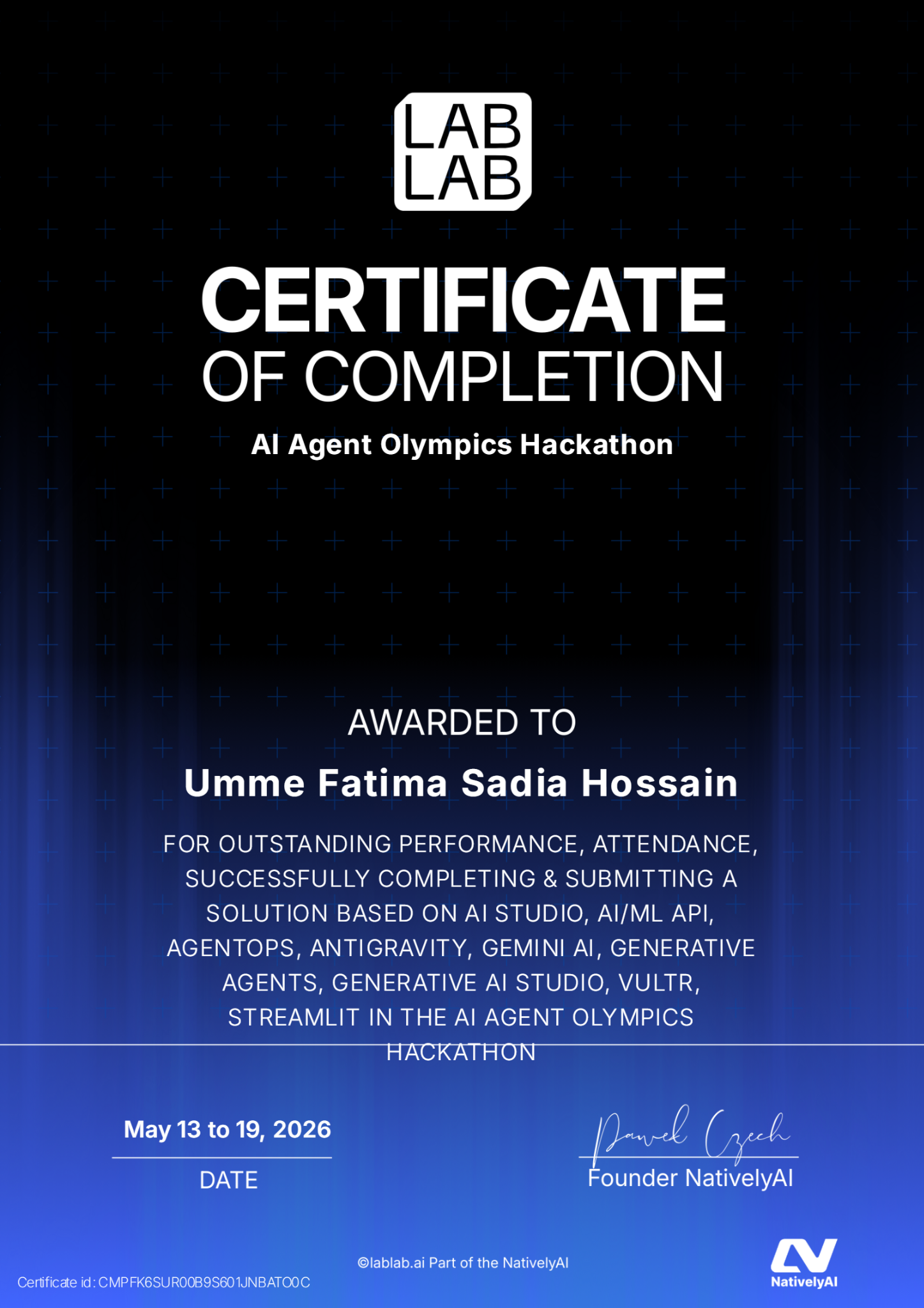
AI Agent Olympics
Lablab.ai · NativelyAI
06
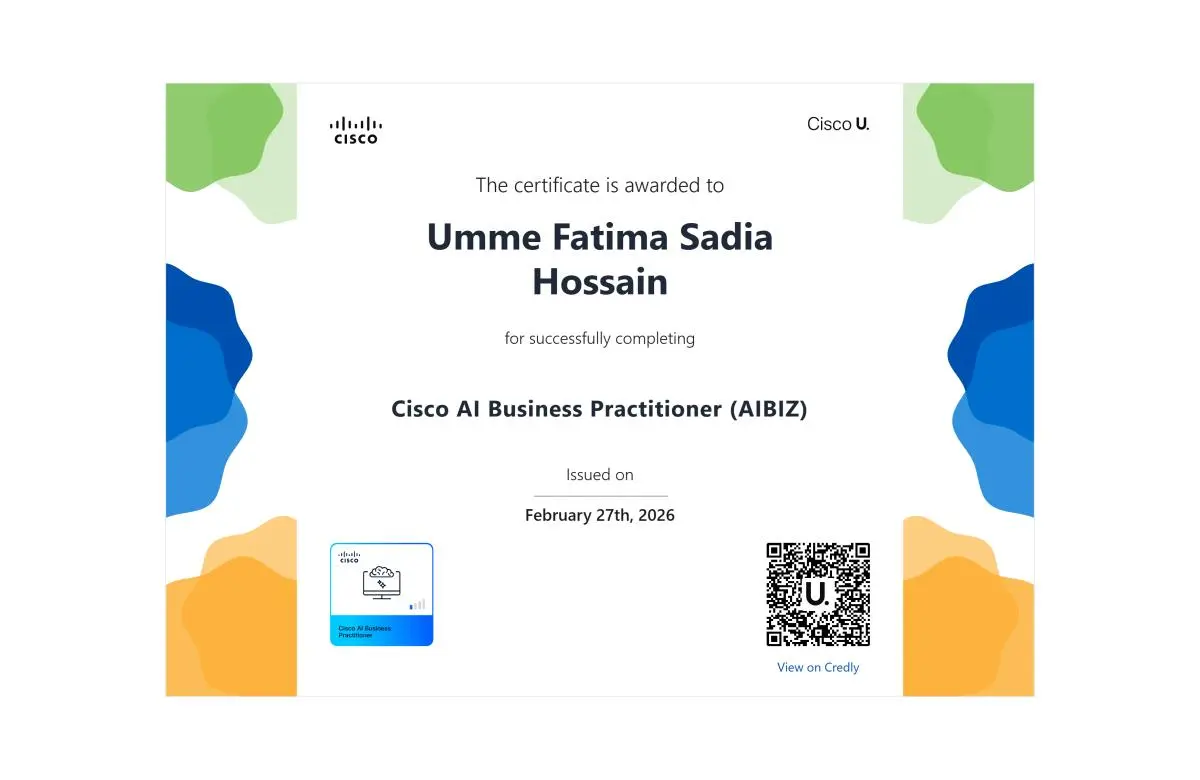
Cisco AI Business Practitioner
Cisco U. · Issued 27 February 2026
07
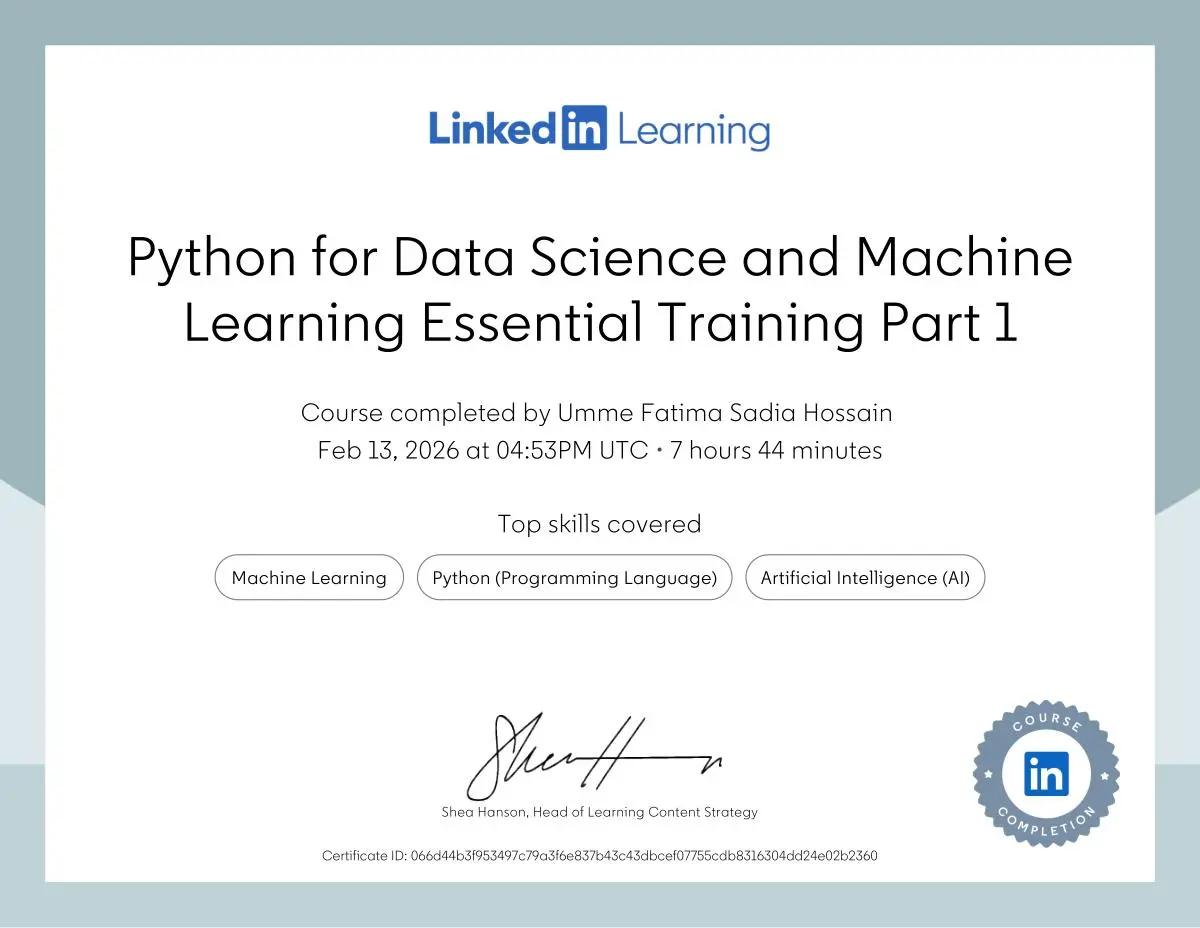
Python for Data Science & Machine Learning
LinkedIn Learning · 7 hours 44 minutes
08
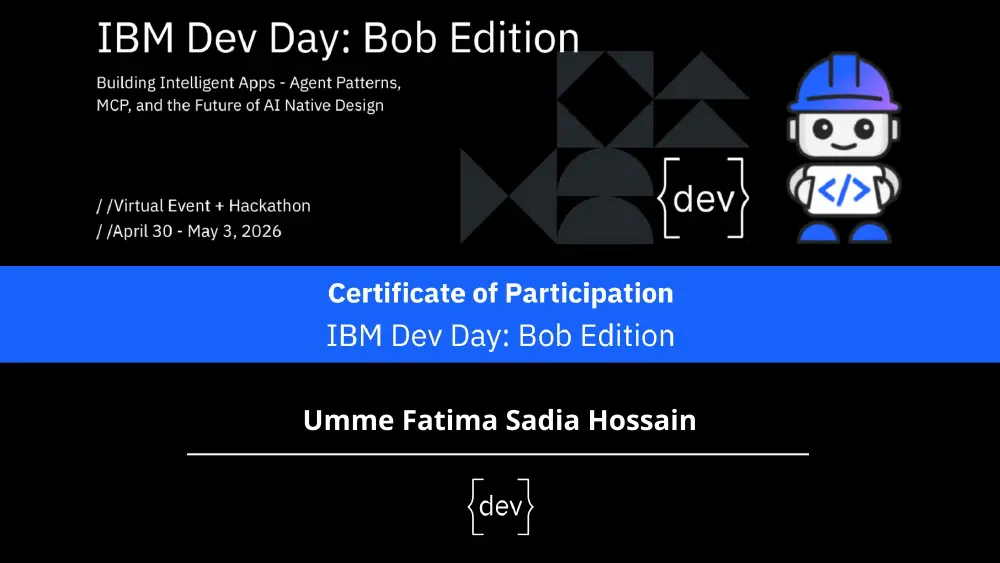
IBM Dev Day — Bob Edition
IBM developer programme · 30 April—3 May 2026
Let's connect
Let's build reliable AI and backend systems that matter.
Open to AI and backend engineering roles, graduate research opportunities and collaborations in responsible AI, decision support and public-impact technology.